
Good pinata assortment planning gives every size, theme and mechanism a clear customer need, reorder rule and space allowance.
A wholesale catalogue can make variety feel free. In reality, every additional design creates another buying decision, sample reference, barcode, carton identity and warehouse location. The range becomes harder to manage before the customer has seen any benefit.
The starting point should be the store’s demand: who buys, for what occasion, at what price and how far in advance. Then select a small evergreen base, add deliberate size or mechanism choices and use seasonal products only where the selling calendar supports them.
This approach works for an online retailer, distributor or party-supply shop because it connects product variety to replenishment and space, not just to a colourful category page.
Give each part of the range a job
| Range role | Customer need | Buying discipline |
|---|---|---|
| Evergreen birthday core | Year-round party use | Hold the deepest stock and clear reorder points |
| Mini favor or decoration | Lower price, table setting or gifting | Control piece count, individual pack and display |
| Standard game product | Main break-open activity | Balance theme, filling space and retail price |
| Pull-string option | Alternative party format | Explain mechanism clearly and test function |
| Large statement piece | Visual impact for events | Allocate freight and storage separately |
| Seasonal layer | Halloween, Christmas or short campaigns | Work backward from the receiving window |
Adult birthdays and nightlife events are a separate customer job, not just another color variant. Use the adult occasion planning guide to decide whether that demand belongs in core stock, a measured test or event-only purchasing.
Give every SKU a role, a reorder rule and an exit rule
This prevents a colorful opening order from becoming permanent slow stock. The buyer should know why each product exists and what evidence will decide its second order.
- Assign evergreen, test, seasonal, mini, mechanism or statement-piece status.
- Set the intended customer, selling price band and warehouse allowance.
- Define the sell-through level and date that trigger a reorder.
- Define when a seasonal or weak design will be reduced or discontinued.
- Review margin and cube by role rather than ranking every product on unit sales alone.
Oliver’s factory view: When a buyer sends a long list, I ask which designs they would reorder first if half the list sold out. The answer usually reveals the true core range.
Choose breadth only where customers see a difference
Two designs that serve the same occasion, price and visual style may simply divide sales. Keep both only when there is evidence that the customer sees a meaningful choice, such as a different age group, mechanism, size or cultural theme.
A food-themed range can look broad while repeating the same shopper role. The food pinata selection guide separates evergreen icons, promotional shapes and test SKUs.
Color variants also count as inventory. If each color has its own label and carton identity, a three-color product is not one simple SKU from the receiving team’s perspective.
- Map every SKU to an occasion or customer segment.
- Set a target retail price band and size role.
- Mark evergreen, test and seasonal status.
- Identify the mechanism and filling expectation.
- Estimate carton and shelf or warehouse space.
- Set a reorder or exit rule before the first delivery.
Use a core, test and seasonal allocation
Put most units in products you expect to replenish. Use a smaller portion for experiments that answer a clear question, and keep seasonal inventory limited by the receiving and selling calendar.
The percentages will vary by business, so the value is not one universal formula. The value is separating the roles. A buyer should be able to explain why a seasonal product is shallow and why an evergreen product is deep.
Review sell-through by role after arrival. A mini product may turn quickly because it is an add-on, while a large pinata may move slowly but generate stronger margin and visual attention. They should not be judged with one identical target.
Plan assortment and cartons together
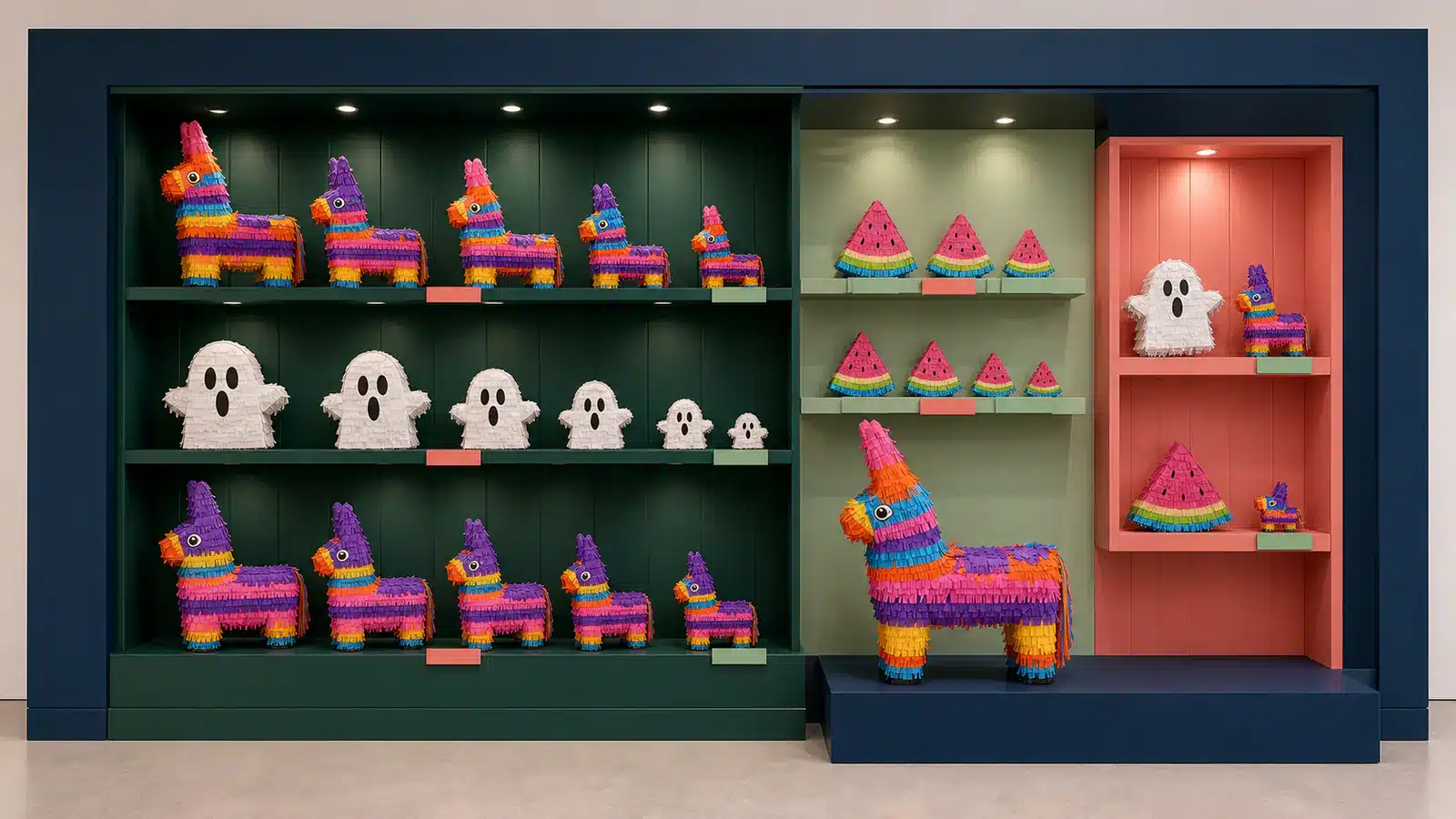
A colourful mix can still be a poor import program if the large and protruding designs consume most of the volume. Ask for preliminary packing assumptions during selection and final carton data after sample approval.
Decide whether cartons contain one SKU or an approved store-level mix. Single-SKU cartons simplify inventory. Mixed cartons may support distribution to smaller stores, but they need stronger count and mark control.
Make sure the receiving team can identify a design without opening and handling every product. Clear carton marks and SKU images prevent damage and misplaced stock.
Example: a range that can grow after the first season
A retailer launches with four evergreen birthday designs, two mini favor themes, one pull-string item, one large event piece and two seasonal tests. The evergreen range receives the largest unit depth and a defined reorder point.
After eight weeks, the buyer compares sell-through, margin and space by role. One mini theme becomes a core item, the large piece remains event-only and only one seasonal concept is carried forward. The second order becomes broader because the first order created usable evidence.
Related buyer resources
- Wholesale Pinatas Buying Guide for Retail Buyers
- Low-MOQ Pinatas for Mid-Sized Retailers: What Is Realistic?
- Mini Pinatas Wholesale: Sizes, Uses, MOQ and Packing
Give every SKU a reason to be in the range
Send the candidate designs, customer type, target prices, selling windows and storage limits. We will help organise the range into core, test and seasonal production groups.
Frequently asked questions
How many designs should a first assortment include?
There is no universal number. Use storage, MOQ per design, selling space and the ability to learn from each SKU to set the width.
Which items belong in the core?
Evergreen birthday, number and broadly recognized shapes often provide a useful base, then seasonal and local themes add differentiation.
How should mini and large pinatas be used?
Mini items can support add-on and favor use; large items can create display impact but require more storage and freight planning.
What makes a test useful?
A clear hypothesis, enough units to observe demand, consistent placement and a pre-set reorder or exit decision.