

A mixed design pinata order works when every SKU has a clear quantity, approval reference and carton rule.
Retailers need variety. Factories need enough depth in each production group to prepare materials, repeat the approved shape and control labels and counts. A good mixed order respects both realities.
The common mistake is to treat the total as if the designs disappear inside it. Six hundred units may sound substantial, but six unrelated designs at one hundred each create six approval references and several packing decisions.
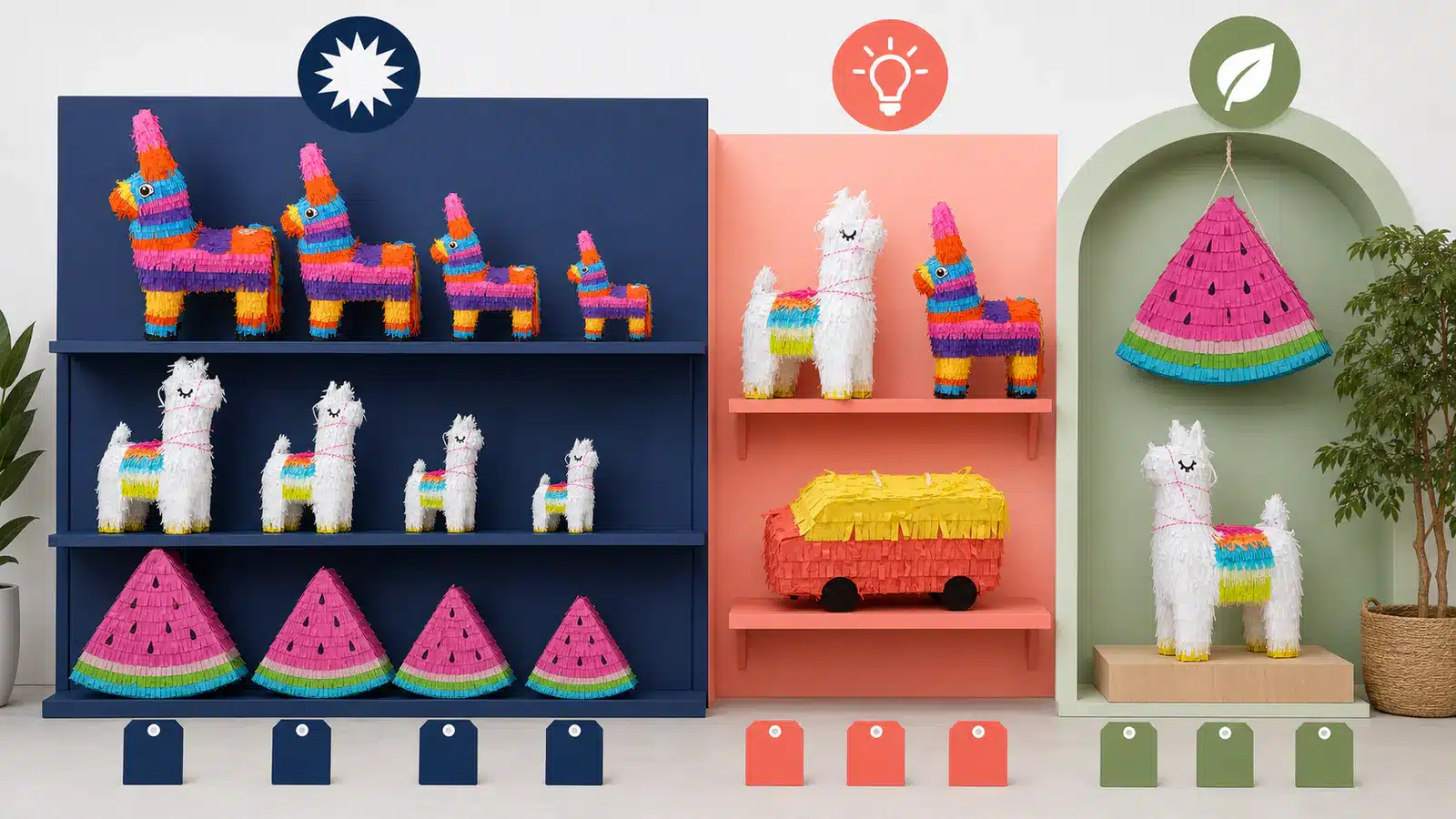
Mixing is most useful when every design has a role: evergreen volume, a mini entry price, a seasonal test or a custom feature product. It becomes expensive when the buyer adds designs only to make the catalogue look larger.
Separate the order into production groups
Catalog items, new custom shapes, pull-string products and private-label versions may require different samples or control points. Even when they ship together, they should not be treated as one undifferentiated product.
- Design and color quantity
- Catalog or custom status
- Mechanism
- Label or barcode version
- Individual packing
- Carton or mixed-carton rule
Create a mixed-order control row for every SKU
A mixed order works when production, packing and receiving all use the same SKU map. The grand total should be the result of the rows, not a substitute for them.
- Record design, color, quantity, mechanism and catalog or custom status.
- Attach the current sample or approval reference to each design.
- Map the correct label, barcode and individual pack to the SKU.
- Choose single-SKU cartons or write the exact recipe for a mixed carton.
- Set the sales result that will trigger a reorder, reduction or exit.
Oliver’s factory view: I am comfortable with a mixed order when the SKU table is clear. I become concerned when the buyer knows the total quantity but has not decided how many pieces belong to each design.
Use variety to test a hypothesis
Choose designs because they test different customer needs. A mini product can test favors or add-on sales. A large product can test event demand. Evergreen birthday shapes can provide a reorder base while one seasonal product tests timing.
If two designs answer the same customer need at the same price, keep the one with the clearer reason to win. More variety is not automatically more useful information.
Keep approval and carton identity clean
Every SKU needs one current reference. If labels or barcodes are used, map the final file to the design and show how cartons will be marked. A correct product packed under the wrong identity is still a receiving problem.
Ask whether cartons will contain one SKU or an approved mix. Mixed cartons can support store-level assortments but require more careful count and labeling.
Choose single-SKU or mixed cartons deliberately
Single-SKU cartons are easier to receive, count and replenish. They also allow the buyer to allocate stock by design without opening cartons. Mixed cartons may make sense when a distributor sends the same store-ready assortment to many small locations.
A mixed carton needs a written recipe. State the quantity of every SKU inside, the outside mark, any inner separation and how shortages are handled. Do not let the packing team create a “balanced mix” by visual judgment.
| Carton route | Best fit | Control needed |
|---|---|---|
| Single SKU | Central warehouse and separate replenishment | SKU, count and carton mark |
| Fixed mixed assortment | Repeated store launch packs | Exact recipe and total pack count |
| Buyer-specific allocation | Several branches with different needs | Packing list by destination or branch |
The carton route can also change freight efficiency. Review it after the product sizes and protection are known, then keep receiving simplicity in the calculation instead of optimizing cube alone.
Example: six designs with one functional exception
Five products are normal break-open pinatas and one uses a pull-string mechanism. Two animal shapes have protruding legs. The purchase order shows quantity, mechanism, label and pack rule for every SKU.
The pull-string item receives a function check, and the animal shapes receive separate packing approval. The order still ships as one program, but the risks are controlled where they actually occur.
When to reduce the number of designs
Reduce the assortment when quantity per design becomes impractical, sample approvals exceed the buyer’s capacity, carton identification becomes complicated or the warehouse cannot support the volume.
A narrower first order usually produces better sell-through data. Add the next layer after the buyer knows which designs deserve depth.
Before the goods arrive, decide how the second order will be different. Set a sales threshold for each role, a final date for seasonal replenishment and a rule for discontinuing weak designs. Keep the approved files for the winners stable so the reorder can move without reopening every design decision.
When one SKU sells faster, deepen it rather than automatically adding another variation. Mixed orders create value when they help the buyer learn and then concentrate inventory—not when the same shallow mix is repeated forever.
Related buyer resources
- Low-MOQ Pinatas for Mid-Sized Retailers: What Is Realistic?
- Pinata Packaging and Carton Planning for Irregular Shapes
Send the mix at SKU level
Show the quantity, design status, mechanism, label and pack rule for every item. We will identify which products can share the order and which need separate approval.
Frequently asked questions
Can different catalog designs be combined?
Potentially. The factory must review quantity per design, availability and carton planning.
Can custom and stock designs be mixed?
They can be quoted together, but development, approval and timing may differ.
Does the total order quantity determine MOQ?
Not by itself. The minimum can apply per design, color, size, pack or packaging component.
What is a sensible trial approach?
Use a focused core, a smaller test group and an explicit reorder plan rather than equal quantities across many designs.