

There is no honest standard pinata packaging specification because a flat star, a tall number and an animal with legs do not stack in the same way.
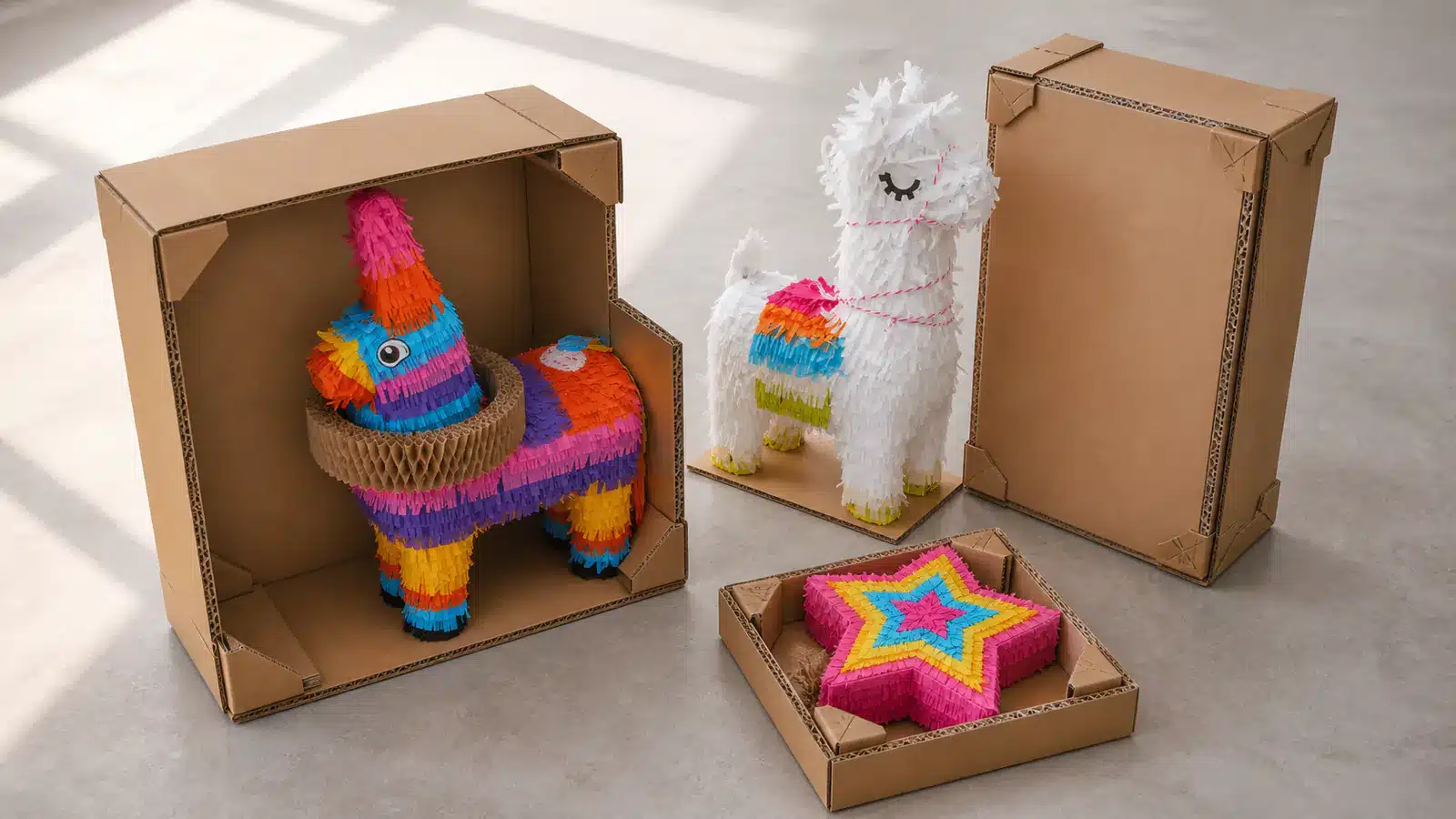
Pinatas are light, hollow and irregular. Fringe can be flattened, ears can bend, legs can become load-bearing by accident and tall shapes can leave unusable space beside them. A box that looks generous may protect the product but make the freight commercially impossible.
The factory and buyer therefore have to solve two problems together: preserve the approved silhouette and keep the carton volume under control. Solving only one creates either damage or an expensive shipment.
Packaging decisions begin during the sample stage, not after production. A small change in protrusion length, body depth or hanging orientation can save more space than trying to force finished products into a universal carton.
Map the shape before choosing the box
Identify which surfaces can carry pressure and which cannot. A compact round body may stack predictably. A donkey may have legs, ears and a tail that create several crush points. A seven-point star distributes its volume differently again.
| Shape feature | Packing risk | Decision to test |
|---|---|---|
| Long protrusion | Bending or wasted side space | Support, shorten, reposition or isolate |
| Loose fringe | Flattening or snagging | Bag, wrap direction and pressure limit |
| Tall narrow body | Tipping and inefficient carton width | Orientation and internal support |
| Broad flat face | Surface pressure and artwork damage | Face protection and stacking direction |
Approve packaging in two stages
Use a provisional packing assumption for the quotation, then replace it with measured carton data after the approved product and protection method have been tested together.
- Stage one: identify crush zones, retail presentation and any warehouse carton limits.
- Stage two: approve the actual individual protection and carton orientation.
- Open the trial pack and check shape recovery, fringe and protruding parts.
- Record units per carton, outer dimensions, gross weight and carton count.
- Send the same dated packing version to the factory, buyer and forwarder.
Oliver’s factory view: Buyers sometimes ask for carton dimensions before the sample exists. I can give a planning estimate, but the reliable number comes only after we know the exact shape, protection and pack orientation.
Choose the level of individual protection
Bulk protection, a simple bag, a retail-ready box and a gift presentation are different products commercially. The buyer should say how the item will be displayed, whether it needs a barcode and how much unpacking labor the warehouse can accept.
More packaging can improve presentation but also adds material, labor and volume. For a low-priced party item, an elaborate box may cost more than the customer values. For a branded event piece, surface protection may be essential.
- Bulk-protected for distributor repacking
- Individual bag for clean handling and labels
- Retail box for shelf presentation
- Hang tag or barcode without a full box
- Moisture or dust protection requested by destination
Test orientation, nesting and folding honestly
Some designs can sit inside one another or use empty spaces efficiently. Others cannot be nested without crushing the fringe or changing the approved shape. Foldable construction can reduce volume, but it transfers assembly work to the buyer and must be tested as a separate product system.
Do not assume compression is harmless because paper is light. Once fringe or a protruding structure is permanently flattened, the product may no longer look saleable even if the body is not torn.
A trial pack should be opened and inspected, not only photographed before closure. The buyer needs to know how the item recovers after realistic handling.
For a side-by-side buying decision, the foldable versus rigid guide connects carton savings with setup labor, shape recovery and the customer’s unboxing experience.
Record final carton data after approval
- Approve the product shape and important attachments.
- Approve individual protection and orientation.
- Trial the proposed units per carton.
- Record outer length, width and height.
- Record gross weight, net weight and carton count.
- Confirm carton marks, SKU labels and photo evidence.
These figures become the buyer’s freight and warehouse inputs. They should be linked to the approved pack, not copied from a different design.
Example: a tall number and a compact star
The tall number leaves space beside its narrow body and needs support to stop it leaning. The star stacks more evenly but the points cannot carry concentrated pressure. Both pieces may have similar scale weight, yet their units per carton and protection are different.
Instead of asking which carton is standard, the buyer approves one pack for each shape family and uses the resulting volume to decide whether the assortment still fits the margin and warehouse plan.
Make packaging part of the quotation
Tell the factory whether the quotation assumes bulk protection, an individual bag, a label, a barcode or a retail box. Ask which information remains provisional until the sample is complete.
If your forwarder or warehouse has a maximum carton dimension or weight, provide it early. The packing solution can then develop with the product instead of becoming an emergency after production.
Related buyer resources
- Large Pinatas Wholesale: Construction, Freight and Handling
- Foldable Pinatas Wholesale: Storage and Shipping Trade-Offs
- Private Label Pinatas: Labels, Barcodes and Retail-Ready Packaging
Show us the shape and the warehouse constraint
Send the product, quantity, retail presentation, maximum carton limits and destination. We will review the crush zones, proposed protection and when final carton data can be confirmed.
Frequently asked questions
Why can’t packaging specifications be standardized?
Every shape, size, attachment and retail presentation changes how the product can be protected and packed.
When are carton dimensions final?
After the product and protection method are confirmed. Preliminary figures should not be treated as final freight inputs.
Can private labels and barcodes be added?
They can be reviewed, but location, artwork, packaging minimum, cost and timing must be confirmed for the order.
What evidence should I request?
Ask for an agreed packing sample or clear photos showing individual protection, pack count, carton closure and marks.