
The custom shaped pinata manufacturing process turns a flat idea into a recognizable, usable and repeatable hollow product that can survive packing and shipping.
Most custom projects begin with a front image. The factory still has to decide what happens on the side and back, how much depth the body needs, where it will hang and how the end user will add candy or small gifts. A dramatic drawing can create a poor physical product if those questions are postponed.
Because the structure is light and much of the colored paper is applied by hand, long horns, narrow handles, thin legs and separate lettering deserve special attention. Some can be supported. Some should become wider or flatter. Others are better represented through surface decoration.
The sample is where the buyer and factory settle that interpretation. Once it is approved, bulk production should repeat the approved solution rather than redesign the product piece by piece.
Convert a flat reference into six physical decisions
| Decision | Question to answer |
|---|---|
| Silhouette | What must a customer recognize immediately? |
| Depth | How thick should the body look and how much filling space is needed? |
| Support | Which joints or projecting parts need reinforcement or simplification? |
| Surface | Which details are built, layered or represented by colored paper? |
| Function | Where are the filling opening, hanging point and mechanism? |
| Packing | Which direction protects the fragile parts with the least wasted space? |
Give front, side and back references whenever possible. If only a front exists, mark which side and back choices are flexible so sampling does not stop over details the buyer does not care about.
Approve the shape as an object, not as a front image
A production-ready decision needs enough information for another person to make the same interpretation. The factory should not have to invent the back, depth or filling access during bulk work.
- Approve front, side and back views together with finished dimensions.
- Identify the silhouette and features that must remain recognizable.
- Confirm the hanging point, filling opening and requested mechanism.
- Mark fragile projections that may be widened, shortened or flattened.
- Approve the protected product inside the proposed pack before final cartons.
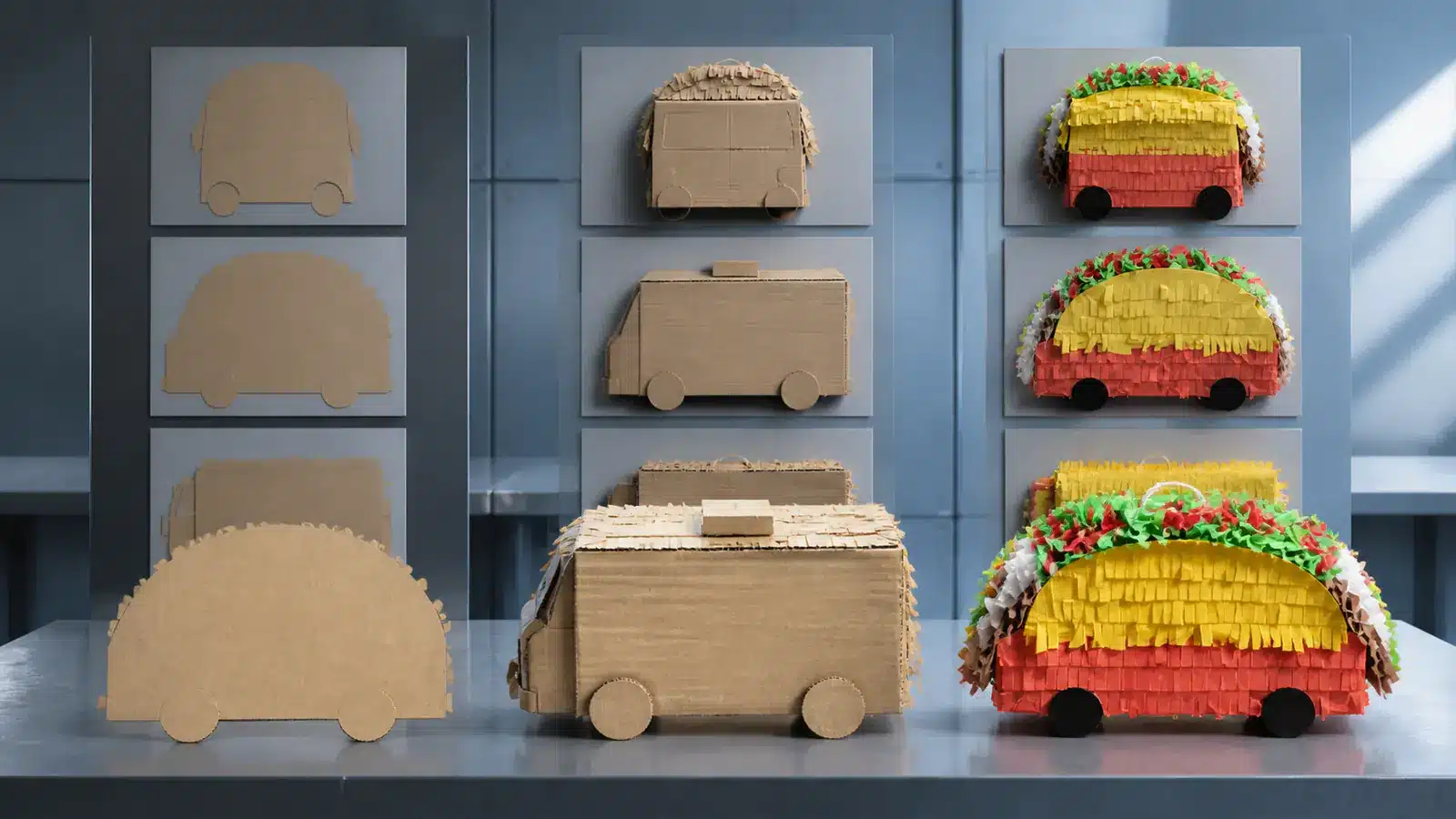
Oliver’s factory view: I do not judge a custom shape only from the front. I turn it in my mind, look for the weakest connection and imagine it inside a carton. That usually reveals the decision the buyer needs to make next.
Protect recognition before decoration
A custom product normally succeeds because of its outer shape and major proportions. Start there. An animal may need the right head-to-body ratio; a product replica may depend on one angled shoulder; a character may need two distinctive ears.
If the object reproduces branded packaging or merchandise for a campaign, continue with the product replica pinata guide. That article focuses on recognition hierarchy, artwork permission and event approval rather than repeating this manufacturing process.
Small decorative features come later. If a detail is invisible at normal viewing distance or creates a weak projection, replace it with a flatter layer. This is not lowering quality. It is directing labor toward the parts that make the idea work.
Food shapes show why recognition comes first: a taco, cake or fruit usually depends more on its silhouette and two or three color cues than on tiny garnish. See how buyers can plan food-shaped pinatas.
- Keep a clear main viewing angle.
- Widen connections between major parts.
- Shorten projections that create large empty carton zones.
- Use layered paper instead of tiny three-dimensional parts.
- Preserve access to the filling opening after decoration.
Use the sample to set an acceptable handmade range
About 80% of our pinata production is manual. The approved sample should therefore define critical dimensions, silhouette, color blocks and attachment locations, while allowing small differences in fringe spacing, overlap and symmetry that do not change appearance or function.
Photograph the sample from consistent angles and record important measurements. If a physical sample is shipped, keep the same documented views so the production team and buyer are not relying on memory.
A change to the outer shape, size or mechanism after approval is a design revision, not a small color correction. Treat it as a new decision because it can affect labor, materials, hanging and cartons.
Test packing before the shape becomes inventory
Pinatas contain useful empty space for the end user’s filling, but that same volume costs money in freight and storage. Protruding parts create more empty space and may prevent stable stacking.
After sample approval, test the product with its actual protection. Look for crushed fringe, bent joints, rubbing between colors and pressure on the hanging point. The final carton count and dimensions should come from the approved product and pack, not from a generic table.
If a small change to the angle of an ear or the length of a handle improves carton utilization without hurting recognition, make that decision before bulk production.
Example: a vehicle with mirrors and a handle
The concept image shows narrow side mirrors and a thin raised handle. Both read well in a rendering but create weak connections and extra carton width.
The sample widens the mirrors and represents the handle with layered surface paper. The body silhouette and approved colors remain strong, the piece hangs level and the carton protects it without a large unused zone. That is a better custom product than a more literal but fragile copy.
Related buyer resources
- Custom Pinatas: Design and Manufacturing Guide
- Pinata Packaging and Carton Planning for Irregular Shapes
- Custom Logo Pinatas for Brands and Corporate Events
Send the front, side and back idea
Include target size, quantity, use, must-keep features and any carton or shelf limits. We will identify the structural decisions before sampling.
Frequently asked questions
How do you start a custom shape?
We review the reference, quantity, size, use, mechanism and packing needs, then identify details that require clarification before sampling.
Can the factory simplify my design?
Yes, after buyer agreement. Simplification can improve recognition, repeatability and packing without losing the concept.
How is the sample approved?
By agreed photo, video or physical sample, with one revision included in the current process.
Does a complex shape change MOQ?
It can. MOQ is set per product after material, handwork and production setup are reviewed.