

A star pinata looks simple from the front, but point length, body depth and hanging balance decide whether it is easy to make, protect and use. Buyers should approve the whole three-dimensional shape, not only the graphic outline.
The word star can describe a compact five-point party shape, a traditional multi-point form or a large display piece with long cones. These are different products with different cultural context, handwork and packing pressure.
Every point adds surface work and a possible crush zone. Long narrow points create more drama but require more room and protection. Shorter points may be easier for retail handling while still giving a clear silhouette.
The hanging point should keep the body readable in use. If the star tilts after it is filled, the buyer may see an edge rather than the intended front view.
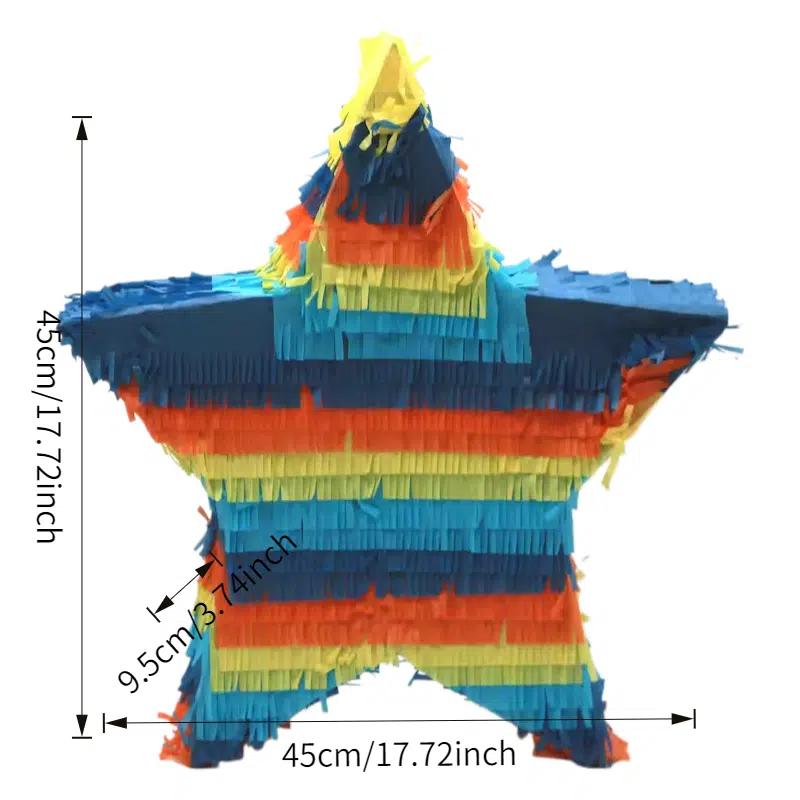
Approve point shape, depth and balance together
Start with the context. If the buyer wants a traditional seven-point Christmas or Posada star, say so explicitly and treat that cultural form accurately. If the need is a general five-point birthday star, do not add traditional meaning that the product is not meant to carry.
Give the factory the point-to-point size and body depth. Ask where the measurement begins and ends, and whether tassels or fringe extend beyond it. A long point may determine the carton even when the centre body is compact.
Test the sample from the front, side and hanging position. The carton trial should show how points are supported without pressing the fringe flat or bending the shape.
Four choices change a star pinata quickly
| Choice | Commercial effect | What to approve |
|---|---|---|
| Point count and length | Recognition, handwork and carton footprint | Full silhouette and cultural context |
| Body depth | Candy space and shipping cube | Side view and usable opening |
| Finish and colors | Retail theme and manual paper work | Physical sample under normal light |
| Hanging position | How the star presents when loaded | Attachment, balance and intended contents |
Example: a dramatic point becomes the carton dimension
A retailer compares two stars with the same centre body. One uses short points and the other uses long cones. The long-point version appears more impressive, but its outer carton needs extra clearance on every side.
If the larger visual effect earns a higher event price, that may be a good trade. If both products sell at the same price, the compact star may create stronger inventory economics because more units fit the freight and storage plan.
The correct decision is not “short points are better.” It is whether the extra scale has a clear retail or cultural purpose that pays for the added handwork and volume.
What I look for in the sample
I look at the star from a few metres away first. The points should read as one balanced shape. Then I look closely at how the paper meets around the point bases, because that is where rushed handwork becomes visible and where the carton can press the structure.
Check how the star will be displayed before choosing depth
A star may hang from the ceiling, sit against a wall or appear as the central event object. The same product can look very different in those positions. Ask the buyer to show the normal viewing side and available display depth; a deep centre may be useful for contents but awkward on a shallow retail fixture.
For wholesale packing, compare the star with the other shapes in the same order. Long points can create unused spaces that are not obvious from the unit count. A buyer may decide to keep the dramatic star as a limited display SKU while placing deeper inventory behind a compact shape. That is a range decision, not a judgment that one design is better in every situation.
Define the star before requesting the price
Include these details so two quotations describe the same object:
- Five-point, seven-point or another specific form.
- Point-to-point width, height and body depth.
- Traditional, seasonal, birthday or promotional context.
- Break-open, pull-string or display-only use.
- Color and finish references.
- Quantity per design, destination and retail-pack request.
Watch the parts outside the centre body
- A centre diameter is mistaken for the full product size.
- Traditional and generic star forms are described as interchangeable.
- Long points are approved without a packing trial.
- The hanging point is checked empty but not with intended contents.
- Several colorways are ordered before one construction is approved.
Send the full star dimensions
Send the intended star form, complete dimensions and event context. We can confirm which details belong in the sample and keep provisional carton assumptions separate from final packed measurements.
Frequently asked questions
Are all star pinatas traditional seven-point stars?
No. General party stars may use other forms. State whether cultural tradition or a simple star silhouette is the objective.
Which star dimension should I request?
Ask for the full point-to-point height and width plus body depth. Clarify whether tassels or loose fringe are included.
Do longer points hold more candy?
Not necessarily. Much of the usable cavity may remain in the centre body, while the points mainly change appearance and carton footprint.
Can star pinatas be pull string?
Some can, but the working mechanism must be built and tested in the exact design. Do not infer function from ribbons alone.