

Pinata landed cost is often driven by the empty space inside the product and carton—not by the product weight printed on the packing list.
The hollow body is useful because the end customer needs room for sweets, small toys or other party contents. During international shipping, however, the same empty space occupies a carton, a container position and a warehouse location. A product can be very light and still be expensive to move.
That is why the factory price cannot answer whether an item will make money for the importer. The buyer needs the final packed dimensions, the correct trade term, the freight route and destination charges before the retail margin becomes reliable.
This guide gives you a working landed-cost structure for comparing designs and suppliers. It does not replace a forwarder’s current rate or a customs classification decision; it tells you which real inputs to collect and when.
Start with the final packed shipment
Do not calculate from the sample’s product weight. Use the packing list developed after product and protection approval: carton count, outer dimensions, gross weight, net weight and total cubic volume. Irregular designs may need different cartons even when their selling prices are similar.
For air and courier shipments, carriers commonly compare actual weight with dimensional or volumetric weight and charge the higher result. DHL explains this principle in its volumetric-weight guidance. Confirm the current divisor and rules with the carrier providing your rate.
| Packed input | Where it comes from | Why it matters |
|---|---|---|
| Carton dimensions | Approved product and pack trial | Determines volume and dimensional weight |
| Carton count | Final units per carton | Connects order quantity to freight and handling |
| Gross weight | Packed carton measurement | Used where actual weight governs |
| Shape mix | SKU-level packing plan | Explains why one assortment uses more space than another |
Build landed cost in layers, then add space
Calculate one version from the final packed shipment and keep every assumption visible. The result should explain both cost per sellable unit and the warehouse space required to hold it.
- Start with the quoted product and packaging cost at the named FOB point.
- Add current freight, insurance, duty, tax, brokerage and local delivery.
- Include required testing, inspection, storage and financing costs.
- Divide by sellable units, not only ordered units, when allowing for damage.
- Compare unit margin, carton cube per unit and weeks of inventory cover together.
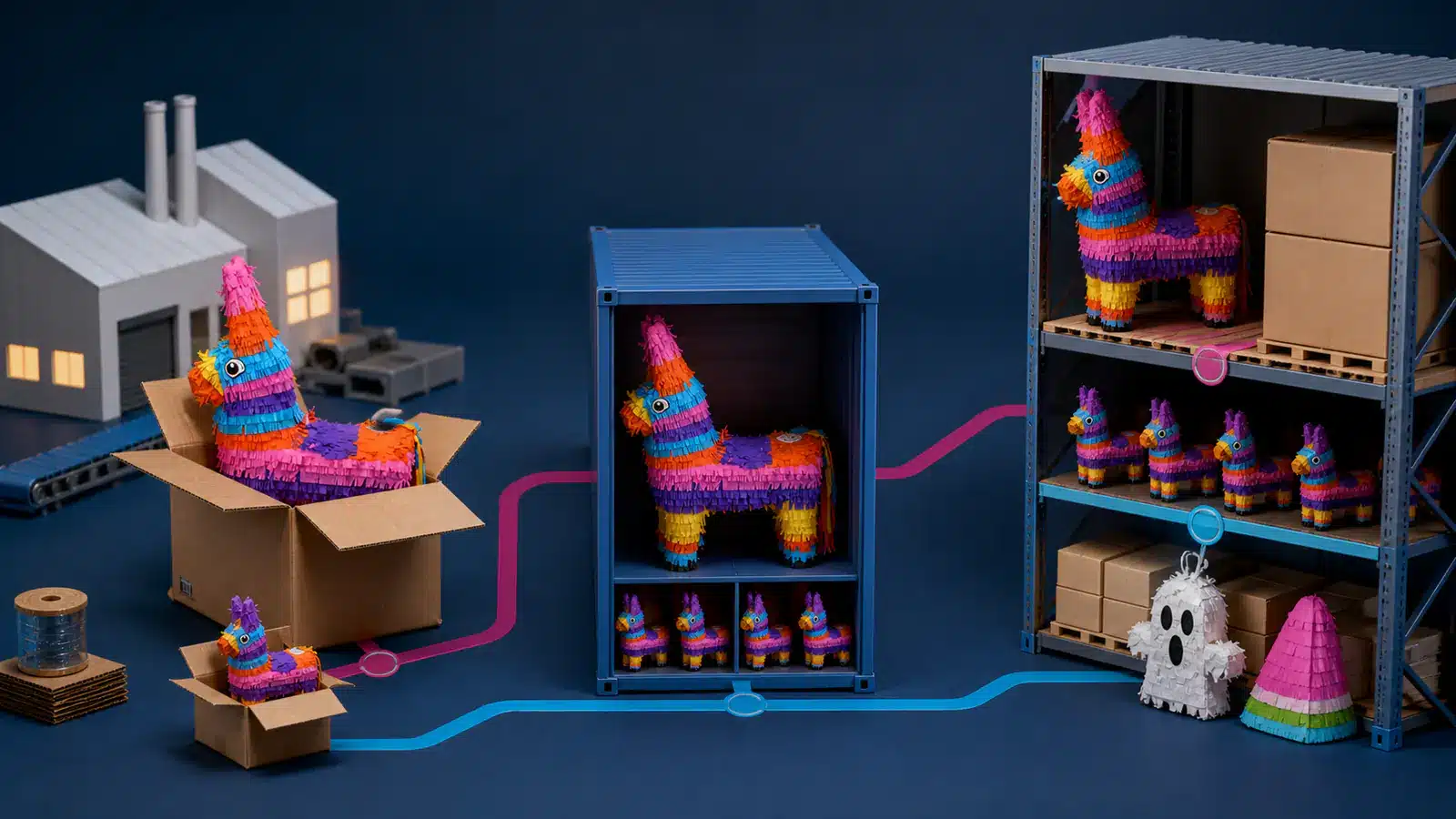
Oliver’s factory view: Buyers sometimes ask me to make the product lighter. The product is already light. The bigger commercial question is usually how to reduce wasted carton space without crushing the shape or fringe.
Build the calculation in layers
- Product and agreed packaging cost at the quoted basis.
- Origin costs not already included in that basis.
- Main international freight and fuel or route surcharges.
- Cargo insurance when arranged by the buyer.
- Customs duty and import tax based on destination treatment.
- Brokerage, terminal, handling and local delivery.
- Inspection, testing or document costs required for the order.
- Expected damage, storage and financing cost over the selling period.
Our current bulk export quotation basis is FOB, with the named port stated in the offer. Under that working structure, the buyer or forwarder normally develops the main carriage and destination side. Make sure the forwarder prices the same carton version that appears in the supplier’s final packing list.
Compare cost per unit and cost per cubic metre
Unit landed cost answers whether the retail price supports margin. Landed cost per cubic metre helps you see which designs consume the freight and warehouse. Use both. A large statement pinata may have a good margin per piece but still be a poor stock item if its weekly sales do not justify the space.
Add an inventory view: how many weeks of cover will arrive, how many cartons can be stored safely, and whether the product can be replenished in time. A lower per-unit price from a very large order may create a higher total ownership cost if stock moves slowly.
- Landed cost per sellable unit
- Gross margin and contribution per unit
- Carton volume per sellable unit
- Warehouse volume and weeks of cover
- Estimated damage or markdown allowance
- Reorder lead time and stockout risk
Use container options as planning constraints
Ocean equipment includes standard dry and high-cube options. Maersk lists common types such as 20-foot dry, 40-foot dry and 40-foot high-cube containers in its container guide. The forwarder should confirm the equipment, internal limits, route and actual usable load for your shipment.
The commercial point is simple: pinatas may fill available cube before reaching a meaningful weight limit. Ask for a carton-level loading estimate and leave practical space for loading, irregularity and cargo handling instead of dividing one published container volume by a perfect carton block.
If the order does not justify full-container planning, compare consolidated ocean and other services using the same final carton data. A route with a lower headline rate can still carry more destination charges or longer storage exposure.
Example: two shapes with the same factory price
A compact star and an animal with long legs have the same factory unit price. The animal needs more protection and leaves unused zones in the carton. The freight allocation and warehouse volume per animal are therefore higher.
The buyer can respond in several ways: retail the animal at a higher price, reduce its share of the assortment, adjust the projecting parts before approval, or keep it only as an event-led item. Landed-cost work does not merely report a problem; it helps decide which product belongs in the range.
Related buyer resources
- Shipping Pinatas from China: Volume, FOB and Import Planning
- Low-MOQ Pinatas for Mid-Sized Retailers: What Is Realistic?
- Wholesale Pinata Price: What Buyers Should Compare
Calculate from the final carton version
Send the SKU mix, destination and forwarder requirements. After the product and protection are approved, we will provide the carton data needed for a real landed-cost comparison.
Frequently asked questions
What is landed cost?
The total cost to receive usable inventory at the agreed destination, including product, logistics, import and destination charges.
Can the factory calculate my duty?
The importer or customs broker should confirm classification and destination charges. The factory provides order and packing documents.
Why is volume important?
Pinatas can occupy significant space relative to weight, so chargeable volume can drive freight.
When should I update the estimate?
At quote comparison, after sample/pack approval, when final carton data is issued and when the freight rate is booked.