
A wholesale pinata price is useful only when the dimensions, design detail, quantity per SKU, packaging and FOB handover are the same.
Buyers often receive three quotations with three different unit prices and assume the decision is obvious. Then they discover that one product is smaller, another excludes the sample or individual pack, and a third uses an FOB port that creates different local charges.
Pinatas are material-light but labor- and volume-sensitive. About 80% of our production work is manual: people form the structure, prepare colored paper and apply decoration piece by piece. A complex small design can require more handwork than a simple larger one.
The purpose of this guide is not to defend a high or low price. It is to help a buyer normalize the offer and see which specification choice is creating the difference.
Break the price into six practical drivers
| Driver | What the buyer should compare |
|---|---|
| Size and depth | Same finished measurement method and usable form |
| Shape | Simple body or multiple projections and support points |
| Surface work | Color changes, fringe coverage, layered features and attachments |
| Quantity per design | Real production depth, not only total order units |
| Development | Catalog repeat, new sample, revision and approval route |
| Packing and FOB | Individual protection, retail components, cartons and named port |
Ask suppliers to price the same product table. If one recommends a cost-saving change, show that option separately so the buyer can choose it consciously.
Normalize these lines before comparing unit prices
Put every supplier on the same scope. If a supplier proposes a cost-saving change, keep it as a separate option so the buyer can see what changed rather than comparing two different products.
- Same finished size, depth and measurement method.
- Same quantity per design, color and packaging version.
- Same sample, revision and approval scope.
- Same individual protection, retail components and carton assumption.
- Same currency, payment schedule, named FOB port and exclusions.
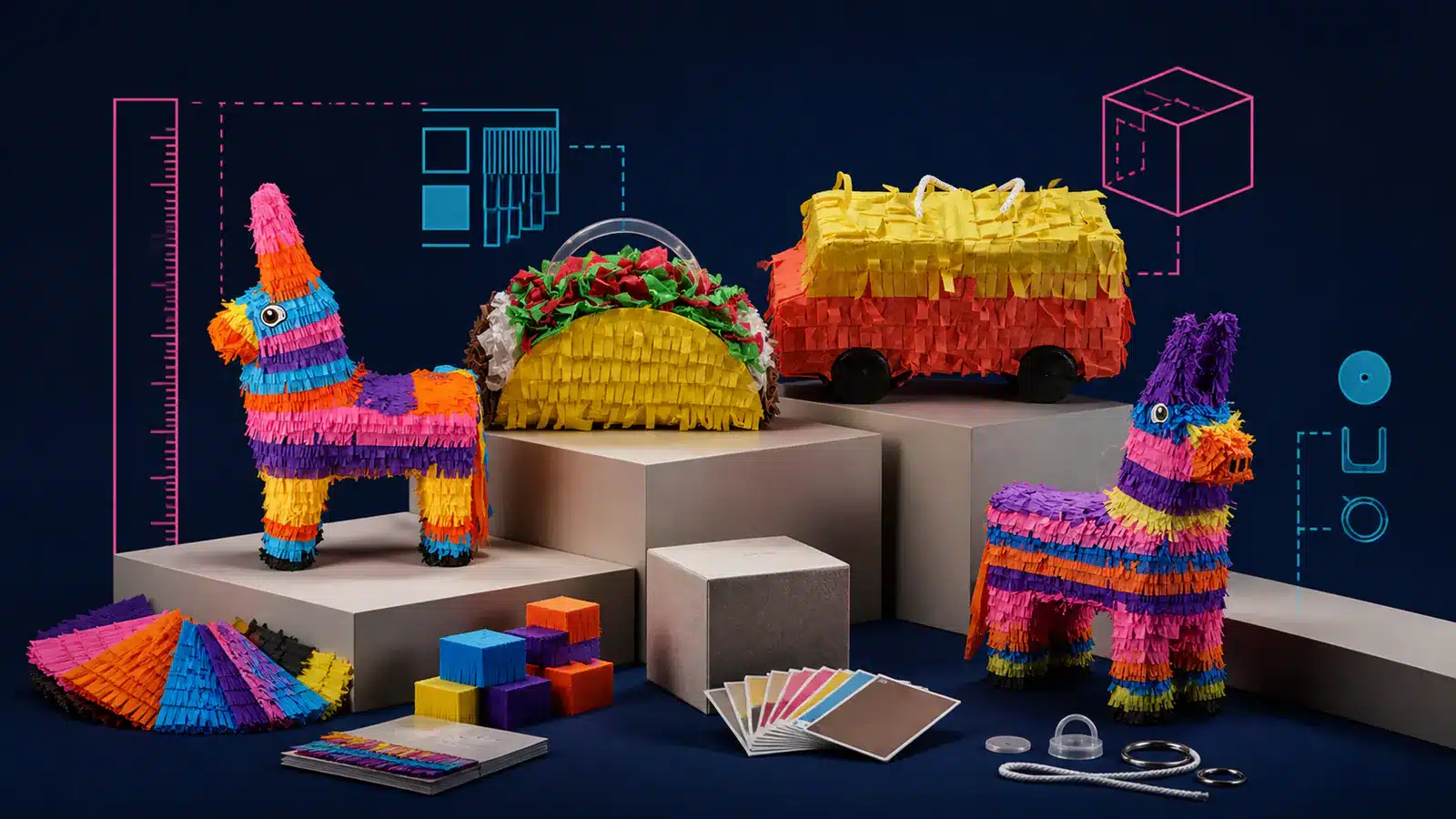
Oliver’s factory view: When a price looks unusually low, I first check whether the size, quantity per design or packaging has changed. Most large differences come from a different scope, not from magic efficiency.
Understand why handwork changes the curve
A machine-made box may reduce unit cost sharply when the run grows. Pinatas still require many manual steps even at higher quantities. Larger runs can improve material preparation, repetition and line organization, but they do not remove the people needed to apply paper and handle irregular shapes.
The number of designs matters because every design restarts part of the preparation and approval process. One thousand units of one established design are not commercially equivalent to one thousand units divided across twenty new shapes.
- Count quantity per design and color.
- Identify new structures separately from repeat products.
- Mark fragile or projecting parts.
- List every label and packaging version.
- Keep the same sample and revision scope across quotes.
Do not let packaging disappear from the quote
A pinata is mostly empty space so the end user can fill it. That means the carton can affect the commercial result as much as a small product-price difference. A cheaper item that needs a much larger carton may create a higher landed cost and consume more warehouse space.
Packaging specifications cannot be standardized across every shape. During quotation, ask for the stated assumption. After sample approval and packing development, replace the assumption with units per carton, dimensions, gross and net weight, marks and total cartons.
If a quote excludes retail bags, boxes, labels or protection that you need, add them before comparing totals. Do not compare a bare-product offer with a retail-ready offer.
Normalize commercial terms before choosing
Our current bulk export quotations use FOB. The named port belongs in the comparison because FOB Shanghai and another named point are not interchangeable labels. Payment timing, quote validity, sample-credit condition and inspection scope should also be visible.
| Check | Why it matters |
|---|---|
| Currency and validity | Exchange rates or material changes can make an old offer unusable |
| Payment schedule | Cash-flow and production release point differ |
| Sample fee and credit | The headline sample cost may be treated differently after order |
| Named FOB port | Local handover costs and forwarder route must align |
| Exclusions | Testing, courier, labels or special packs may sit outside unit price |
Example: the cheaper unit that costs more to own
Supplier A is slightly cheaper per unit but quotes a large custom shape with no packing development included. Supplier B is slightly higher and proposes a small structural simplification that improves carton orientation.
After final carton data, Supplier B places more sellable units in the same volume and reduces pressure on the buyer’s warehouse. The buyer should compare landed cost, damage risk and space, not celebrate the lower factory line before those costs exist.
Related buyer resources
- Wholesale Pinata MOQ Guide for Mid-Sized Buyers
- Pinata Packaging and Carton Planning for Irregular Shapes
- Shipping Pinatas from China: Volume, FOB and Import Planning
Compare the same product and the same handover
Send the design table, quantity by SKU, sample route, packaging need and named FOB port. We will show what is included and which figures remain dependent on the approved pack.
Frequently asked questions
What affects price most?
Shape, size, handmade detail, quantity per design, sample development, packaging and FOB handover all matter.
Are bigger pinatas always more expensive?
Size usually affects materials, handwork and volume, but a smaller highly detailed design can also be labor-intensive.
Does a higher quantity reduce price?
It may improve setup and material efficiency, but the effect depends on quantity per design and the agreed specification.
Can you give a price without packaging details?
A preliminary product estimate may be possible, but a dependable FOB quote needs a packaging assumption.