
The right pinata supplier is the one whose answers stay specific and consistent when your design, sample, QC, carton and FOB questions become real.
A buyer can find retail pinata stores, Mexican product specialists, trading companies, sourcing agents and direct factories in the same search results. They may all be useful, but they solve different problems. The comparison should begin with the buyer’s order, not with one generic ranking.
A small retailer needing domestic stock may value a local wholesaler’s fast delivery. A brand developing a unique shape may need direct sample and production communication. An importer building a range needs carton data, export documents and a supplier that can work at design-level quantities.
Use the checklist below to normalize the request and reveal which supplier model fits. A beautiful website, low price or large MOQ is not a complete capability test.
Identify the supplier model first
| Supplier model | Where it may fit | Question to ask |
|---|---|---|
| Retail or POD seller | Very small quantities and immediate local delivery | Is the product stocked and what customization is realistic? |
| Domestic wholesaler | Fast replenishment from local inventory | What range, pack and resale terms are available? |
| Trading or sourcing company | Broader category sourcing through one contact | Who makes the product and controls the approved sample? |
| Direct pinata factory | Custom or repeat wholesale production | How are samples, handmade variation, packing and FOB files controlled? |
No model is automatically superior. The risk comes from expecting one model to provide a service it was not built to provide.
Once the supplier model is clear, compare it with the service your order actually needs. This factory-direct buying comparison explains when local stock and support may be worth more than direct factory access.
Score comparable evidence, not confident promises
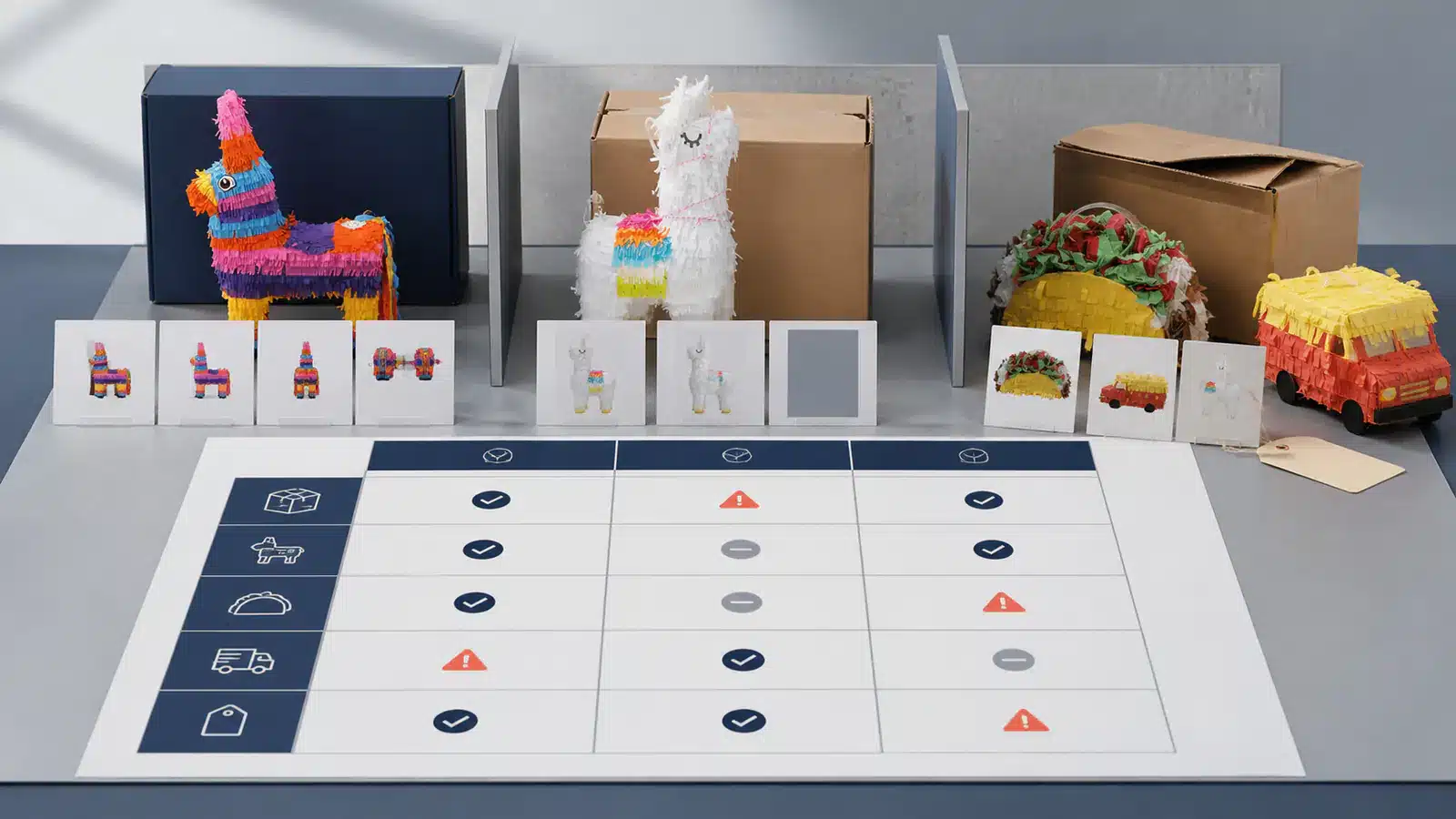
Choose five factors that could damage your actual order, weight them to 100 percent and score only the evidence supplied against the same written brief.
Before finalizing the weights, review the sourcing errors that most often distort a supplier comparison. It helps distinguish a cheap-looking quote from a genuinely lower-risk offer.
- Use the same products, quantities, approval route, packaging and FOB point.
- Record open questions as open; do not convert them into optimistic scores.
- Give more weight to the risks that can miss your launch or destroy your margin.
- Use samples to score communication, revision control and repeatability.
- Choose the supplier whose remaining risks are visible and manageable.
Oliver’s factory view: I do not expect every buyer to choose a factory. If they need twenty pieces next week, local stock may be the right answer. Our strength begins when a buyer needs a repeatable wholesale or custom program and is willing to approve it properly.
Send one normalized test request
Choose two or three representative products and send the same brief to every candidate. Include quantity per design, size, mechanism, custom details, labels, packaging, destination, named FOB port and target date.
Ask each supplier to mark confirmed figures and design-dependent estimates. A supplier that identifies an open carton or artwork question is giving you more usable information than one that confirms everything without seeing the product.
- One established product to test normal execution
- One custom or detailed shape to test interpretation
- One packing-sensitive or functional item
- The same sample and revision scope
- The same commercial term and handover point
- The same required evidence and deadline
Score the answers, not just the numbers
| Area | Strong answer | Weak answer |
|---|---|---|
| Factory identity | Explains selling entity, production entity and payment route | Uses only a marketing name |
| Sample | States timing, revision, views and approval reference | Says “sample available” with no route |
| MOQ | Reviews quantity per design and packaging | Advertises one number for every product |
| QC | Separates critical defects from handmade variation | Promises every piece will be exactly identical |
| Packing | Develops final data from the approved product | Uses one carton formula for all shapes |
| FOB scope | Names the port and lists inclusions | Writes FOB with no named place |
| Confidentiality | Protects customer identity and custom files | Uses other customers’ logos without permission |
Use the sample to test working behaviour
A sample reveals more than appearance. Notice whether the supplier asks useful questions, records the revision, provides complete views and connects the approved version to production and packing.
Do not request a beautiful one-off sample that bulk workers cannot repeat. Ask which features are critical, what handmade range is expected and how early production pieces will be checked.
If third-party inspection or a named test is required, introduce it before the quote. The supplier’s response should explain feasibility, scope and timing rather than making a broad certification claim.
Compare total ownership after the carton exists
The lowest product price can lose when the pack uses more volume, the design arrives damaged or the supplier cannot provide stable reorder references. Compare landed cost, warehouse space, approval effort and recovery options as well as unit price.
For a first order, choose a manageable assortment that can expose the supplier’s real workflow. A trial is valuable when you know what you are evaluating and what result would justify a larger reorder.
A simple weighted scorecard
Weight the factors according to your business. A custom event buyer may give more weight to sample interpretation and deadline communication. A distributor may give more weight to carton efficiency, identity control and repeat production.
- Define the five factors that can damage your order most.
- Give each factor a percentage weight totaling 100.
- Score every supplier only from comparable evidence.
- Record open questions instead of converting them into optimistic scores.
- Choose the supplier whose risks you understand and can manage.
Related buyer resources
- Wholesale Pinata MOQ Guide for Mid-Sized Buyers
- Custom Pinata Sample: Cost, Timing, Revisions and Approval
- Wholesale Pinata Price: What Buyers Should Compare
Use your real order as the supplier test
Send two or three representative products with quantity, approval, pack and destination details. We will answer the same structured brief you can use with every candidate.
Frequently asked questions
How many suppliers should I sample?
Enough to compare credible alternatives without creating an unmanageable approval process. Shortlist from written answers before paying for samples.
Should the lowest price win?
Only after specifications, quantity per design, packaging, sample scope and FOB point are normalized.
What if a supplier will not give customer names?
That can reflect appropriate confidentiality. Ask for process evidence, relevant product samples and a small controlled trial instead.
How should I score suppliers?
Weight the factors that threaten your launch most: product fit, clarity, approval control, pack/freight accuracy and responsiveness.